
Swim with Orcas in Norway: dates, prices, what is included (killer whale snorkeling)
Swim with Orcas in Norway: dates, prices, what’s included and what to expect (version française)
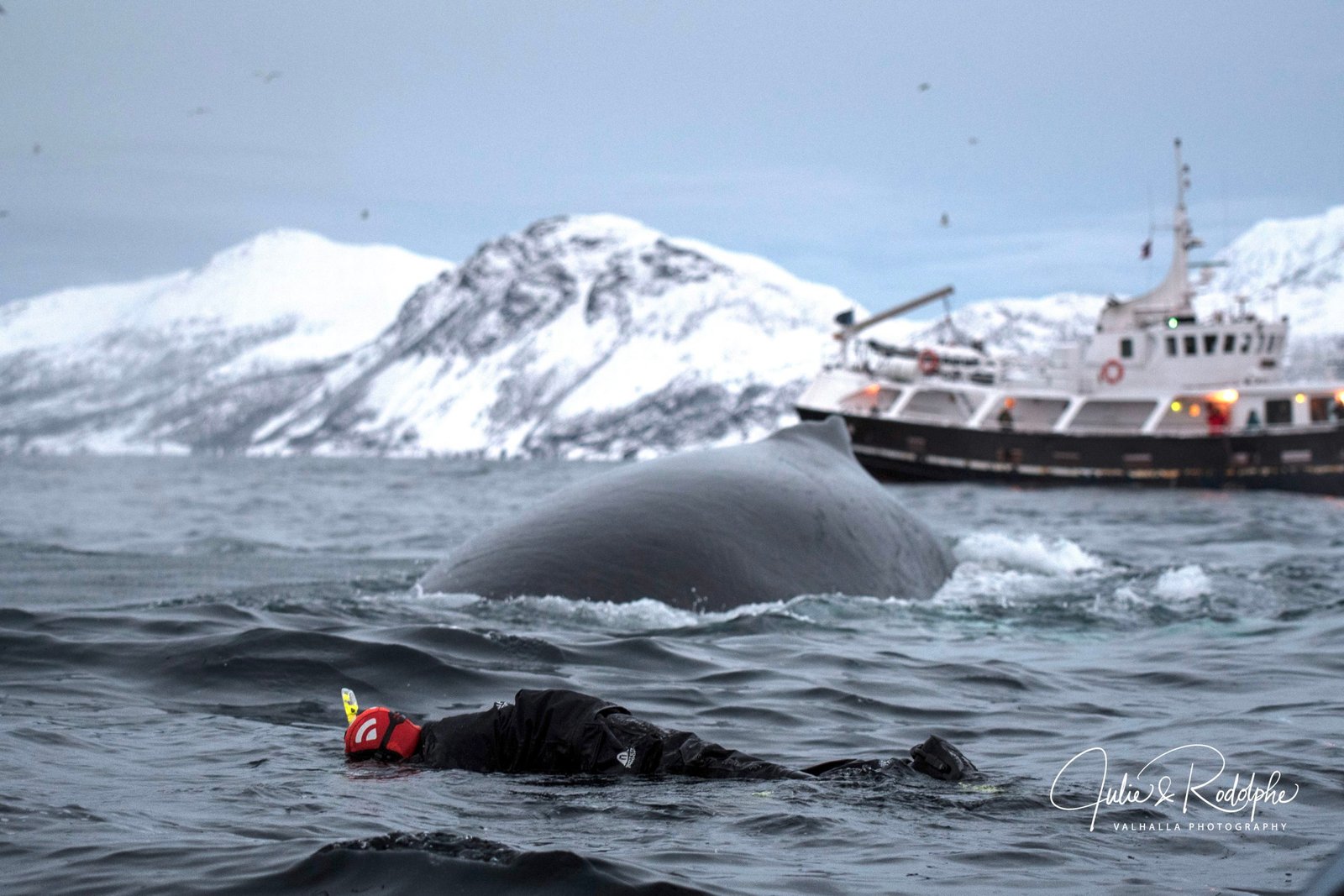
Swimming with orcas in Norway is possible for a few weeks each winter, when the herring pour into the fjords north of Tromsø and hundreds of orcas — also called killer whales — follow them. Valhalla Expedition runs small-group snorkeling expeditions from our Reinfjord base camp at 70°N: ten guests, one guide, a RIB boat, and the wildest encounter the Arctic has to offer. This page gives you everything a traveller needs to decide and book: the exact season and departure dates, the prices, what is included, how a day unfolds, the level required, the weather, the gear — and our answers to the questions we are asked most.
Swim with orcas in Norway — at a glance
- Season: early November to early February (herring run)
- Where: Reinfjord camp, Skjervøy area, 3 hours north of Tromsø
- Format: 3-day (Thursday → Sunday), 4-day (Sunday → Thursday) or 7-day Christmas / New Year weeks
- Group: maximum 10 guests + guide, snorkeling from a RIB boat
- Price: from €2,515 per person, all inclusive (lodging, meals, gear, boat, guide)
- Minimum age: 16 · Level: comfortable swimmer with snorkel, no diving certificate needed
Table of contents
- Why Norway is the best place in the world to swim with orcas
- Season and expedition dates
- Prices and what is included
- How a day with the orcas unfolds
- Swim with a killer whale: same animal, same expedition
- Level required, safety and the cold
- Weather, light and conditions in the Arctic winter
- Gear provided and what to bring
- Underwater: what you will actually see
- Getting to Reinfjord
- FAQ
1. Why Norway is the best place in the world to swim with orcas
Every winter, the Norwegian spring-spawning herring — one of the largest fish stocks on the planet — overwinters in the fjords of Troms. Orcas follow in the hundreds, joined by humpback whales, and hunt in the sheltered, glassy water of the fjords rather than in the open ocean. That combination is unique: nowhere else can you snorkel, legally and ethically, next to wild killer whales feeding in flat, protected water, day after day, from a boat that is ten minutes from your bed. Norway’s regulations and the local knowledge of small operators keep the encounters respectful; the animals are never fed, chased or touched.
2. Season and expedition dates
The orcas are in the fjords from late October / early November until the beginning of February. Our 2026–2027 expeditions run from October 15, 2026 to January 24, 2027 (2027–2028 season: October 14, 2027 to January 20, 2028). Three formats:
- 3-day expeditions (Thursday → Sunday): Oct 15–18, Oct 22–25, Oct 29–Nov 1, Nov 5–8, Nov 12–15, Nov 19–22, Nov 26–29, Dec 3–6, Dec 10–13, Dec 17–20, Jan 7–10, Jan 14–17, Jan 21–24.
- 4-day expeditions (Sunday → Thursday): Oct 18–22, Oct 25–29, Nov 1–5, Nov 8–12, Nov 15–19, Nov 22–26, Nov 29–Dec 3, Dec 6–10, Dec 13–17, Jan 3–7, Jan 10–14, Jan 17–21.
- 7-day Christmas and New Year weeks: Dec 20–27, 2026 and Dec 27, 2026–Jan 3, 2027.
Which weeks are best? November still has a little daylight and often the biggest concentrations of herring; December and early January are the polar-night weeks, with blue light at midday and the northern lights at night; late January brings the light back and calmer seas on average. Sightings are excellent throughout — it is wildlife, so nothing is guaranteed, but in a full season we rarely have a day without orcas. The current calendar with remaining spots is on the expedition page.
3. Prices and what is included
| Expedition | Days | Price per person |
|---|---|---|
| 3-day snorkeling expedition | Thursday → Sunday | €2,515, all inclusive |
| 4-day snorkeling expedition | Sunday → Thursday | €3,285, all inclusive |
| Christmas / New Year week | 7 days | €5,175, all inclusive |
Included: accommodation at Reinfjord camp (shared rooms, sauna and jacuzzi), all meals (full breakfast, snacks and tea time, dinner in the lavvu tent, warm soups at sea, dietary options), the RIB boat and your guide every day, the complete snorkeling kit (10 mm Fladen wetsuit, mask, snorkel, fins, gloves, boots, dry robe), the safety briefing and a training dive, wildlife presentations in the evening, and the private boat transfer between Skjervøy and the camp. Not included: flights to Tromsø, the public ferry Tromsø → Skjervøy (about €50), your 1–2 nights in Tromsø before the expedition, drinks at the bar and travel insurance (mandatory). No hidden extras on site.
4. How a day with the orcas unfolds
Breakfast at first light — which in December means around 9 a.m. The guide reads the wind and the herring reports, then the RIB leaves the camp. We scan the fjords for blows, birds and fishing boats; when a pod is feeding calmly, the boat positions itself ahead of their path, engine off, and guests slip in quietly in small groups, floating at the surface with snorkels. The orcas decide the encounter: sometimes they pass at ten metres, sometimes a curious juvenile circles you, sometimes a whole pod carousel-feeds beneath you in a storm of herring scales. Between drops, warm soup, dry robes and hot drinks on the boat. Back at camp mid-afternoon for the sauna, the jacuzzi under the snow, dinner in the lavvu, a presentation on orca behaviour — and, if the sky clears, the aurora.
5. Swim with a killer whale: same animal, same expedition
Many travellers search for how to swim with a killer whale and wonder whether it is a different trip. It is not: killer whale is simply the common English name of the orca (Orcinus orca), the largest member of the dolphin family. The name comes from old whalers who saw them hunt whales; it says nothing about their behaviour towards people. In more than a decade of swimming with killer whales in Norway, there is no record of a wild orca injuring a snorkeler here. The Norwegian killer whales you will meet are herring specialists — patient, coordinated, curious — and the same rules apply as for every orca encounter on this page: small groups, no chasing, no touching, the animals always free to leave. Whether you call it swimming with orcas or swimming with killer whales, this is the expedition.
6. Level required, safety and the cold
You do not need to be a diver. You need to be a confident swimmer, comfortable floating at the surface with mask and snorkel in open water, and fit enough to climb back onto a RIB with help. Minimum age is 16. The first morning includes a training dive from the camp to test your suit, your weighting and your breathing in cold water before any orca encounter. In the water the guide stays with the group; on the boat the skipper keeps visual contact at all times. The water is 4 to 7 °C: with the 10 mm wetsuit, hood, gloves and boots, most guests stay in comfortably for 20 to 40 minutes per drop, and we do several drops a day. Cold is managed, not endured — the dry robe and the soup are part of the method.
7. Weather, light and conditions in the Arctic winter
The fjords are sheltered, which is why snorkeling is possible at all, but the Arctic winter is real: expect temperatures between −8 and +4 °C, wind, snow showers and days when the boat cannot go out. That is why we ask you to plan one or two nights in Tromsø before the expedition (ferries can be delayed) and why every expedition has flexibility built in — a morning outing on departure day when the weather allows. From late November to mid-January the sun does not rise above the horizon; the light is a long blue dawn from about 9 a.m. to 2 p.m., which is when we are at sea. Visibility underwater is typically 10 to 20 metres in clear conditions, less during the densest herring balls — which is precisely when the action is.
8. Gear provided and what to bring
We provide: 10 mm Fladen wetsuit, hood, gloves, boots, mask, snorkel, fins and a dry robe for the boat. You bring: thermal base layers (merino or synthetic, never cotton) to wear under the suit and on the boat, a warm hat, waterproof outer layers, sunglasses for the low sun, a swimsuit, a towel, your medication, and a camera if you wish — a GoPro on a short pole works well; strobes and big housings need experience. Prescription mask lenses are worth ordering in advance. Pack light: the ferry and the transfer boat have limited space.
9. Underwater: what you will actually see
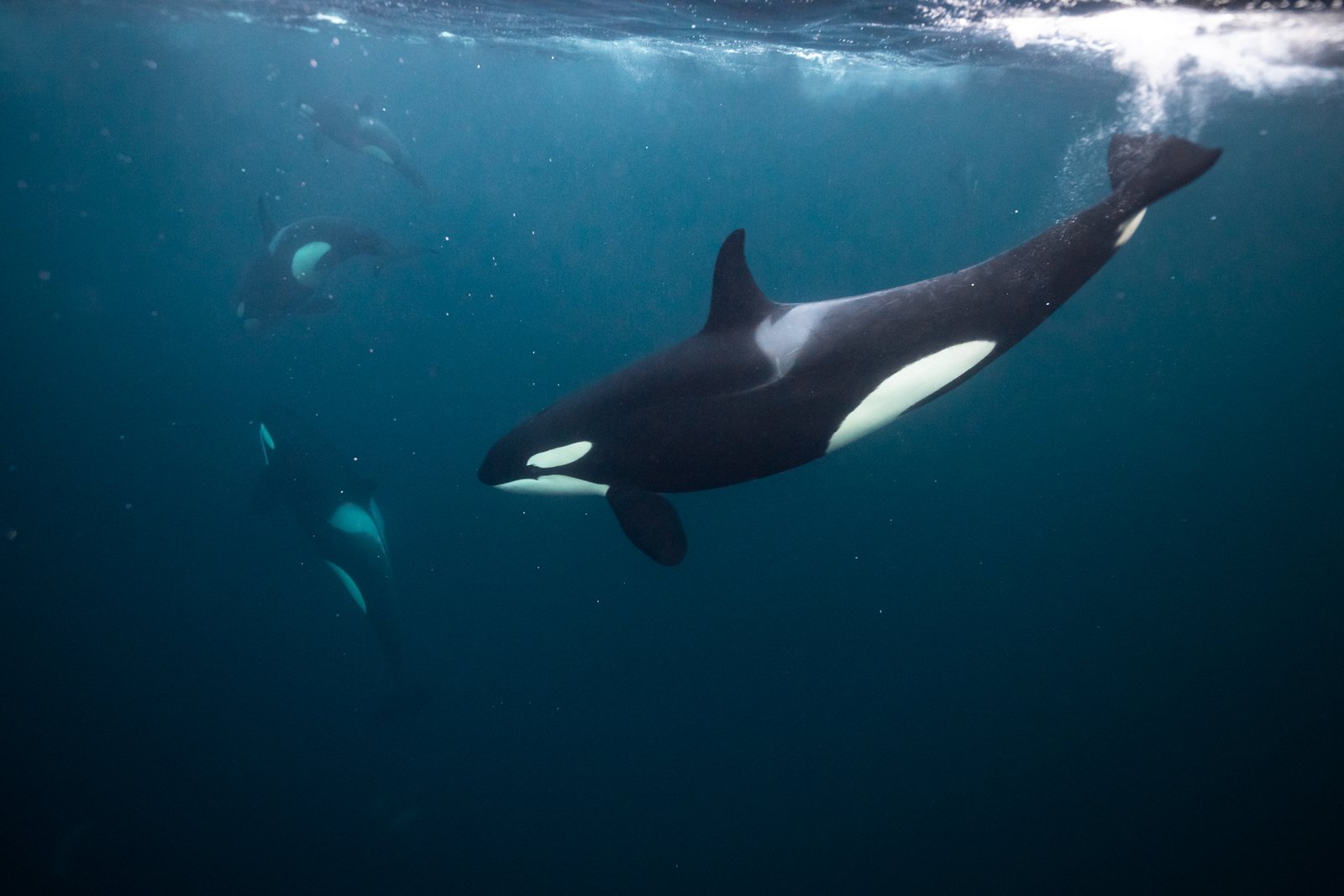
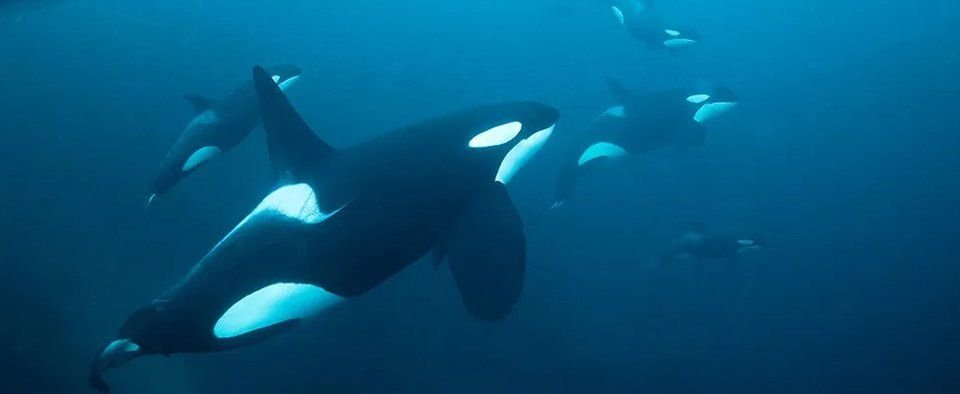

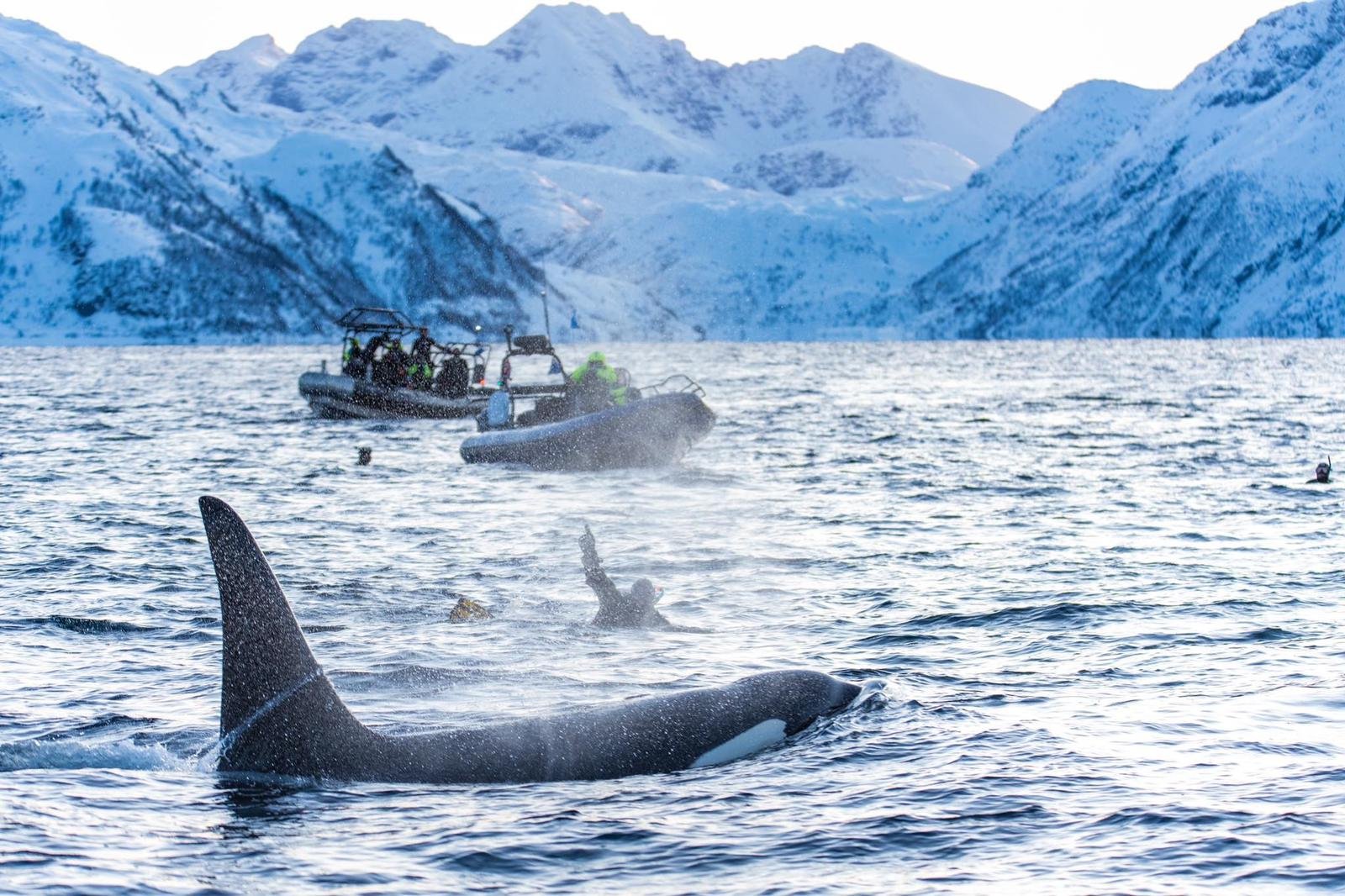
More images and video in our gallery.
10. Getting to Reinfjord
Fly to Tromsø Airport (TOS) — direct flights from Oslo, and seasonal or connecting flights from London, Frankfurt, Paris and other European hubs. Spend one or two nights in Tromsø (our whale-watching guide lists what to do there), then take the public ferry Tromsø → Skjervøy (about €50, roughly 2 h 45); our private boat brings you from Skjervøy to Reinfjord camp, included in the price. The reverse on departure day. Travel insurance covering snorkeling and trip interruption is mandatory.
11. FAQ — swimming with orcas in Norway
Is it safe to swim with orcas in Norway?
Yes, with a small, experienced operator and the rules we apply: engine off, small groups, no chasing or touching, guide in the water. Wild orcas in Norway have never injured a snorkeler; the real risks are the cold and the sea, and they are managed with the gear, the training dive and the skipper’s judgement.
What if the weather stops the boat?
It happens a few days per season. We shift outings within the expedition when possible, and the camp — sauna, jacuzzi, presentations, aurora — is part of the experience. This is also why we recommend arriving in Tromsø a day or two early.
What level do I need?
Confident open-water swimmer, at ease with mask and snorkel; no diving certificate. The training dive on day one lets you get used to the suit and the cold before meeting the orcas.
Is the gear included?
Yes: 10 mm wetsuit, hood, gloves, boots, mask, snorkel, fins and dry robe. Bring your own thermal layers and a hat.
Will I see orcas for sure?
No operator can guarantee wild animals. In a typical season we see orcas almost every day at sea, and often humpback whales too, but a bad-weather week can reduce time on the water. We tell you this before you book.
How much does it cost to swim with orcas in Norway?
From €2,515 per person for 3 days and €3,285 for 4 days, all inclusive except flights, the ~€50 ferry, your Tromsø nights and insurance. See the detailed cost breakdown.
Can I just watch from the boat?
Yes. Some guests choose to stay on the RIB for part or all of the drops; the encounters are spectacular from the surface too. For a boat-only experience from Tromsø, see our whale watch options.
Ready? Dates, remaining spots and booking are on the Arctic Orca Watch expedition page. Questions first? Write to us — we answer personally.